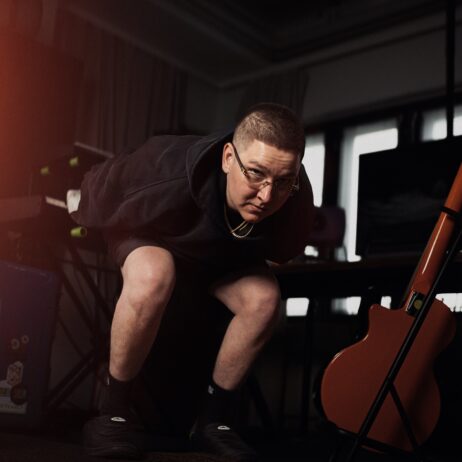
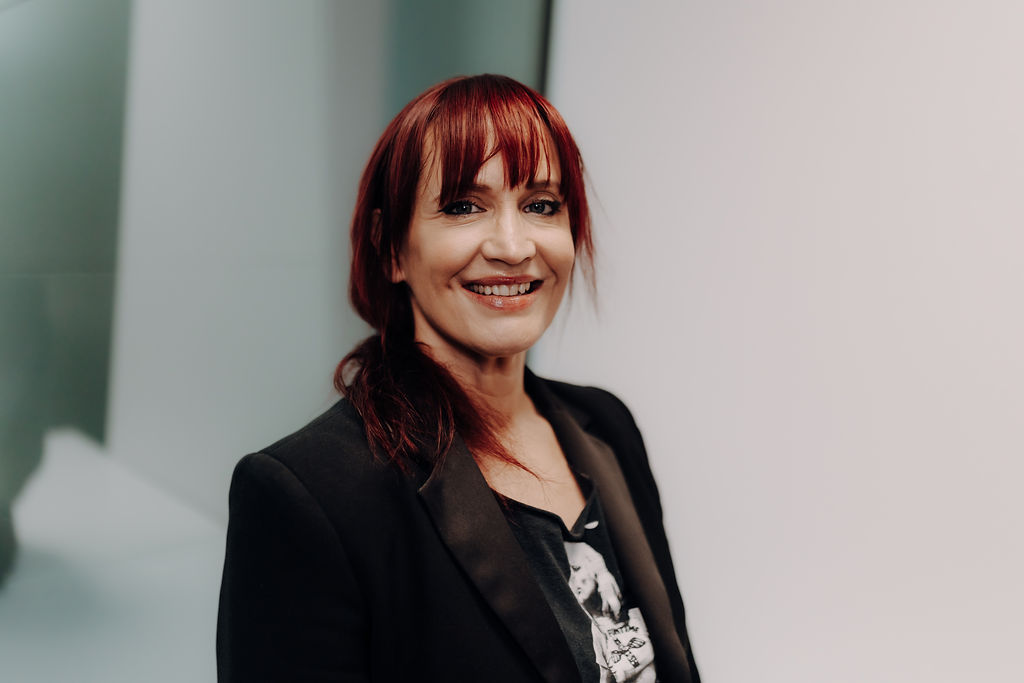
Singer-songwriter Maija Vilkkumaa wants to build value and appreciation for pop music – and, in doing so, also create success.

At the turn of the year, Maija Vilkkumaa was elected to the Board of Directors of Gramex as the first direct artist representative in the organisation’s history.
The new position of trust provides a counterbalance to the everyday life of a songwriter and artist who, in her own words, is currently working on a new album “with crazy intensity.”
Intensity, however, is nothing new for Vilkkumaa.
Her career began in the 1990s, when she founded the band Tarharyhmä together with her friends Minna Haapkylä and Isa‑Eerika Lehto.
– I first heard about Gramex back then, when we were making Tarharyhmä’s first record, sometime around 1992. I’m pretty sure it was TT Oksala, who produced our single, who said that now we need to take care of the Gramex matters. And that’s when we joined.
A turning point in her career came in 1999, when Vilkkumaa recorded a demo of the tango Satumaa at the Harju youth centre.
This led to a recording contract for her debut album Pitkä ihana leikki, followed over the years by six studio albums, two compilation albums and one EP.
Vilkkumaa’s list of awards is among the most distinguished in Finland: five Emma Awards, as well as the Teosto Prize, the Juha Vainio Award and the Finland Prize.
– Sometimes I think to myself that, yes, this really has been quite a long journey. Back then, even Gramex and Teosto notifications were handled in a completely different way… I remember taking long bus rides just to deliver those notifications on paper.
– In a way, I even nostalgically miss that moment: when it was the very last day to submit the notifications, you had to clear the entire day of everything else, because you had to get them done and travel by bus. That day became a bit of a celebration.
– And now, of course, you can’t even imagine that anymore. Now you can file everything online, in the dark hours of the night, guided by some kind of instinct.
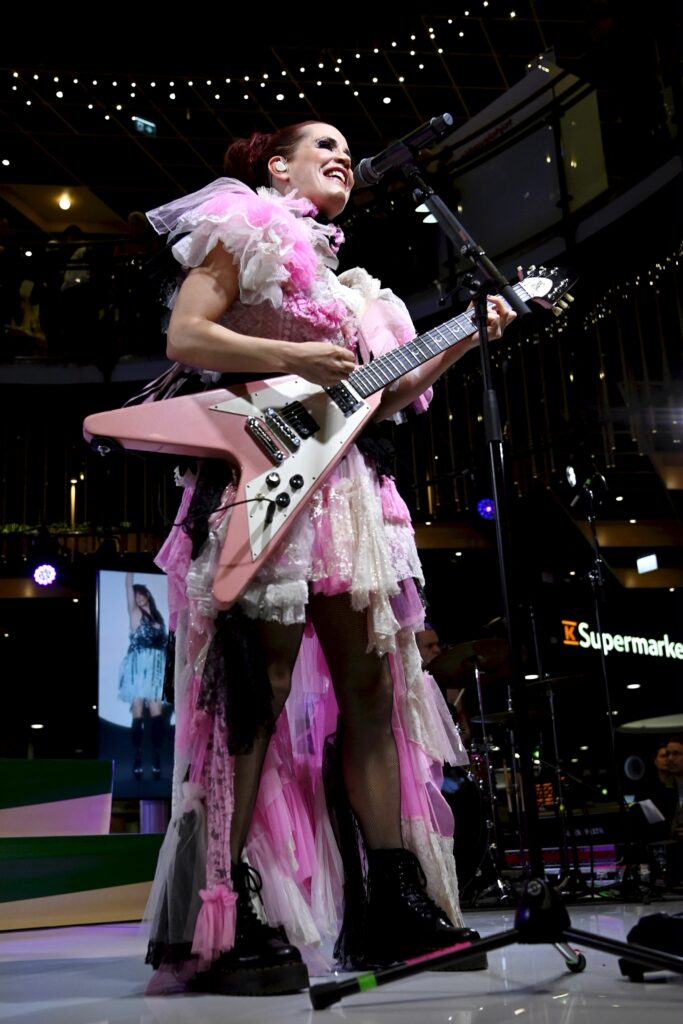
Copyright remuneration paid for radio airplay did not mean just money at the beginning of her career.
– It was 1995 and Tarharyhmä had just broken up. I was at a Pop & Jazz Conservatory camp. I remember walking to the ATM in the centre of Kullaa, hoping that maybe a bit of money from Teosto had come in. At the time, I was basically in debt everywhere, but I still needed to be able to buy some crisps or cider for the evening.
– Then I put my card into the machine and there was 25,000 Finnish markka on it!
– But beyond the money, it also gave me a sense of legitimacy — like, “welcome to the field: you have a function, you matter.”
– That money was a symbol that someone wanted to hear my music, because it had been played.
Later on, the remunerations continued to be important.
– Especially during the years when I was on a break from my solo career, copyright income was really significant. When I was writing a book on a grant, the remunerations at least provided a steady stream of some income.
Vilkkumaa’s debut novel Nainen katolla was published in 2013. On the music side, she returned to her solo career in 2015.
– The way remunerations are distributed has, of course, changed somewhat now that music is often made in producer–artist duos, where the producer creates all the recorded material. But earlier, when I was making my biggest records in the early 2000s, they were very much band albums.
– Back then, Gramex remuneration was a pretty big deal for band musicians. If you had a major radio hit, the payments could be very substantial.
– Today, the livelihoods of artists and musicians are tighter than before — or at least more uncertain.
The scope of an artist’s work has also changed. Online platforms and social media are constantly pushing boundaries.
Some artists even evolve into social media influencers. Last summer, British singer-songwriter Lily Allen began selling photos of her feet on the platform OnlyFans.
Vilkkumaa sees influencer culture as a potential risk — or at least a challenge.
– For artists trying to break through, social media can of course be a useful side hustle, a source of income you can live on. But you can also get stuck there, to the point where you no longer dare to do your own thing and are constantly looking over your shoulder.
According to Vilkkumaa, the world of social media can easily turn into a harmful race and a constant comparison with others.
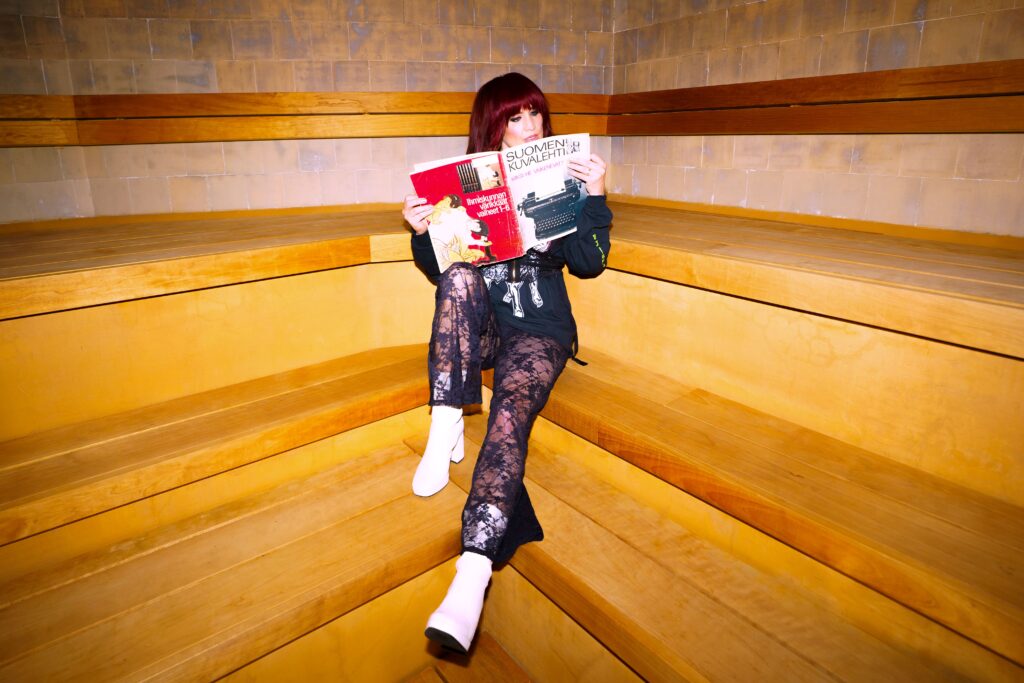
– That’s always present in the social media world: constant comparison with others. You inevitably get the feeling that “oh, they did it like that, maybe I should do the same.” And little by little, your own voice — which everything ultimately rests on — starts to erode.
As a positive example, Vilkkumaa points to Pehmoaino, who broke through in a big way on TikTok with the song Haluan takaisin mun perhoset.
– Pehmoaino could have stayed stuck chasing another similar TikTok moment and competing with the algorithm. But instead, she has gone on to make music and live shows that are truly her own — distinctive in sound and vision, artistic and of a very high standard. She’s currently touring, and the shows are consistently sold out. Pehmoaino dares to build her own world.
According to Vilkkumaa, it is precisely that personal world of the artist that people fall in love with.
– An artist’s popularity is about people falling in love with the artist’s own world. That’s why it’s so important to remember, as an artist, why you started doing this in the first place — and to really immerse yourself in that.
– This has been “the” thing for me ever since the very beginning of my career. Making music is a safe haven for me in a chaotic world.
– I also find it really enjoyable that Miley Cyrus once said somewhere: “I didn’t come into this industry to sell lip gloss, and I’m not going to do it.”
For me, making music is a safe haven in a chaotic world.
According to Vilkkumaa, staying true to yourself is not always easy for an artist.
You have to dare to say no to imagined popularity and money if you don’t genuinely believe in the idea being offered.
– There are plenty of people who will say, “if you do this kind of thing, you’ll become hugely popular.”
And then you have to be able to say no, if you don’t believe in it yourself.
– But this has always been a somewhat psychological field as well. And that’s why the most passionate people tend to make it: an artist needs the strength to sometimes say no without even blinking.
Vilkkumaa believes this also has broader implications for society.
– Respect from the public, decision-makers and structures also requires that creators respect themselves first.
And this is precisely where Vilkkumaa wants to have an impact also as a member of the Board of Directors of Gramex: on value and appreciation.
– My hope, more broadly, is to be involved in building a situation where the value of popular music and its creators in Finland continues to grow. We have strong creators and the potential to go in so many directions.
According to Vilkkumaa, the first thing that needs to be broken is the cycle of negativity.
– In Finland, culture is often seen merely as something that needs subsidies and as an expense item — sometimes even as something that could be replaced with, say, a universal basic income.
This negative attitude, she says, was fully exposed during the COVID crisis.
– For example, during the pandemic, restaurants were kept open everywhere and supported because they were seen as a business sector. But culture was not treated the same way: it was not seen as an industry.
Yet even before the 2010s, it was already well known that the creative, copyright‑based content industries are among the fastest‑growing sectors globally.
– There is genuine growth potential in the field, which is easily forgotten. There is art that is also commercially relevant, while at the same time, of course, retaining art’s intrinsic value.
– And people do value culture enormously. For example, when it comes to Finnish‑language poetry, Finnish‑language pop music plays a hugely important role in people’s everyday lives.
Vilkkumaa hopes that this significance will begin to be reflected more clearly in decision‑making structures as well — and that this, in turn, would also accelerate growth.

– I believe these things are interconnected. If appreciation could somehow be aligned across different areas, it could really spark something big for the entire sector.
Vilkkumaa also believes that a rise in appreciation would help ease the tightening economic situation.
– In many other countries, such as Sweden, both individuals and companies invest significant amounts of private money in music. But that, too, requires the wheel to start turning in the other direction. Without appreciation, there are no investments — and without investments, there are no major successes. And without investment and success, appreciation doesn’t easily grow either. So where do you even begin to untangle this cycle?
Beyond commercial success, supportive structures are also needed. Vilkkumaa points to organisations such as Gramex and Teosto as key examples.
– If everything is left entirely at the mercy of short‑term commerciality, it can easily happen that the market only elevates new artists who are expected to have a five‑year career peak — and then they are forgotten.
– Even though many artists might have very real commercial potential for a strong comeback, all it would take is someone to help carry their career through that dip.
– For example, both Gramex and Teosto are organisations that provide exactly this kind of support, because remunerations continue to be paid long after a song has been created. These organisations give artists a bit of lift — air under their wings.
Giving that kind of lift is also something Vilkkumaa wants to do herself, whether on tour stages, in the studio, on The Voice of Finland supporting newcomers to the field, or as a member of the Board of Directors of Gramex.
And in giving, she also receives.
– It’s rewarding to meet people — fellow board members — who look at the music sector from different perspectives. It helps clarify your own thinking as well.