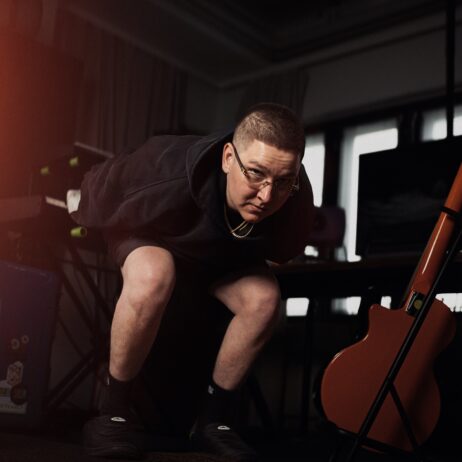
– Today Aliisa has found her voice, said Professor Sakari Oramo, Professor of Orchestra and Conducting, in a class at the Sibelius Academy a few years ago.
The course mates nodded. Yes, this is what happened. Behind us was a day of teaching devoted to conducting an orchestra. Aliisa Neige Barrière, 30, was listening to her professor.
Part of her agreed. Of course, an orchestra leader who leads a group of 100 people must have an audible voice. Then the players in the back row can hear. There is a need for that.
At the same time, Aliisa wished she could find a way to maintain her voice that didn’t conform to the loud conductor’s cliché.
-If you don’t shout, everyone has to shut up and listen. This softens the situation,” says Aliisa.


When Aliisa thinks back to her childhood in the third arrondissement of Paris, she remembers the sound of a violin coming through an open window into the kitchen. The way the notes snaked in and captured her attention. Listening to it, Aliisa knew she wanted the same thing.
The violin had singability and a scale from low to bright. The sound was wonderful and inviting.
– From an early stage, everything I experienced laid the groundwork for the fact that I could not and did not want to think about my life without music. It was an impossibility.
Aliisa’s mother was the internationally renowned composer Kaija Saariaho, who died of brain cancer two years ago. Kaija was 70 years old when she died. Aliisa’s father is the French composer Jean-Baptiste Barrière.

Music was always present in the family. Aliisa and her brother Aleksi, five years older, followed their parents’ work daily and regularly attended concerts with them.
In 2000, Aliisa was five years old. That summer the family spent at the Salzburg Opera Festival. It was rainy, so Aliisa sat with Aleksi, who now works as a director, listening to her mother’s rehearsals.
The child’s memory was not only of the orchestra, but also of the two high towers on stage and the excitement of the opera world. After three weeks, Aliisa knew her mother’s opera L’Amour de loin ( Love from afar ) almost by heart.
The situations Aliisa experienced were something she wanted to be more inside.
– I already thought at the time that one day I wanted to perform the opera myself. It felt natural and right. It was a powerful experience.
It was therefore significant for Aliisa to return last summer to Salzburg, where she worked as assistant conductor to Esa-Pekka Salonen. She prepared the singers for Esa-Pekka’s arrival, gave feedback on the music and was there in case of any illness.
– It was moving to go to work every day in the same space where I sat 25 years ago.
It was always clear to the siblings’ parents that they would not force their children down the path they had chosen. Kaija’s experiences contributed to this.
Kaija, who grew up in Helsinki, fell out with her father at the beginning of her career when she announced that she wanted to become a composer. Her father couldn’t imagine that such a path would be suitable for a woman. Helvi Leiviskä was the only more prominent figure, there were no other examples.
Kaija kept her will.
According to Aliisa, Kaija later interpreted the incident as the father trying to protect his child. Although relations were later restored, the experience left its mark.
– That’s why my mother wanted to make sure I didn’t have the same experience. She asked me at length, “You’re not doing this for me, you’re free to choose something else.
However, Aliisa wanted to pursue a musical career. For some reason, the violin seemed the most inviting of all instruments.
Fateful or not, it was eventually discovered that the sound that had been heard in the kitchen in Paris had come from a violin teacher practising almost next door. He became Aliisa’s teacher for years.
The choir was also one of Aliisa’s hobbies as a teenager. One day, the choir director asked if Aliisa had thought about conducting. The question was surprising. Aliisa hadn’t even considered the option.
– But almost immediately I felt that this would be a natural way to get more fully involved in making music.
Aliisa decided to give it a try. The first time was “shocking in a wonderful way.” It was a choir made up of parents of conservatory students. There were many parents of friends in the ranks.
When Aliisa sat down on the podium, she was nervous. At the same time, she was calm. When the first notes came out, Aliisa shied away. She hadn’t prepared herself for how strong the sound would feel in her body.
– It was an experience that is hard to describe. At some point you get used to it, but you never forget the first time. That’s why I return to the moment regularly in my thoughts. The music plays in us.
When the songs were over, Aliisa received a lot of positive feedback. It was a momentous moment. It felt like there were stars in her eyes.
– I started thinking I want more of this. The dream of conducting an orchestra wouldn’t leave me alone anymore.
At the age of sixteen, Aliisa moved to New York to study. She completed high school while studying violin at a conservatory and later at university. At the conservatory, she was also able to take a few courses in orchestral conducting.
Free time was spent at concerts, exhibitions and the opera. One day Aliisa went to Carnegie Hall, the next to the Metropolitan Opera. On the third she went to hear the Philharmonic and on the fourth she explored experimental making.
– While this was wonderful, at some point it also became a burden. New York is constantly awake and it gives, but it also takes.

Aliisa says she has always had strong opinions about music and how it should be made and performed. The same was true when Aliisa wanted to concentrate on violin and orchestral conducting.
She felt that to become a good orchestra leader, she should also develop as a violinist.
– I’m an introvert by nature, a shy one. But this doesn’t show in music. I have a strong sense of what I’m moving towards and how I’m supposed to move forward.
In 2014, playing the violin felt difficult and painful. Through a cellist friend, Aliisa met Norwegian violin teacher Peter Herresthal.
The contact was immediate.
– I immediately realised that here was a person who could help. One of my challenges as a violinist was over-mobility. I couldn’t control it. Peter understood what this meant.
Peter invited Aliisa to his home for a week, where she shared a room with his daughter. After seven days, Aliisa felt like she knew how to play the violin for the first time in a long time. She began to dream of an exchange to Norway.
– I wrote a melodramatic note to New York saying I had to go north. Fortunately, my dream was made possible.
At the time, Aliisa was still wondering whether she could realise her dream of conducting an orchestra. Would it really be possible?
Three years later, Aliisa met Atso Almila, a former professor of conducting and orchestral training at the Sibelius Academy in Helsinki.
After the concert, Atso asked Aliisa where you had been. The professor remembered Aliisa from a course she had taken years earlier. Atso said that your playing showed that you had certainly developed as an orchestra leader.
– Finally, he told me that I should apply for his next course.
This is what Aliisa did.
During the week-long course, Aliisa reflected on her experiences as a musician. She had almost always performed with male conductors. Many of them were good, but authoritarian characters.
– I didn’t identify with them at all. I wondered if it always had to be like this.
At the feedback session, Atso told Aliisa that he would soon be retiring. Sakari Oramo would take over from here. Finally, Atso said something important. He hoped that Aliisa would apply to study orchestral conducting.
– Atso said that when I step up to the podium, it’s not about me, it’s about the music. It made me think that maybe I can do this work in my own way.
Although emotions were high and uncertainty present, Aliisa decided to give it a try.
– I am grateful that as a young woman I have met many who have said go.
Six years ago, Aliisa went to the Sibelius Academy entrance exams with the attitude that I will try again next year. There are hundreds of applicants to the orchestral conducting course every year. Two get in.
There were many rounds in the entrance exams. One day we read scores, the next we played our own instrument. There was also orchestral conducting and an interview.
Each round, someone dropped out. After each round, Aliisa wondered if this could be true. She made it to the next round.
– I gained confidence because I started to feel that I could succeed.
When Aliisa received hints between the lines that she should look at an apartment in Helsinki, a feeling of unreality bubbled up inside her. After completing her degree in Oslo, Aliisa moved to Finland. Her place at university was secured.
The parents were also excited for their daughter.
– I am glad that my mother was able to see my direction taking shape.

My student days were coloured by the interest. Distance learning, Zoom lectures and small group orchestras. Despite all this, the years were rewarding.
– Sakari was an inspiring teacher. We were honoured that a musician of his calibre wanted to be with us and give of his time and talents.
Aliisa quickly started to get a job. She made her debut in Joensuu, after which she conducted other Finnish provincial orchestras in Lahti, Tampere and Oulu.
Opportunities also opened up abroad, with the Orchestre de Paris and the Mahler Chamber Orchestra.
– Finland is a good country in this respect, because it also gives young people opportunities. This is not the case in France, for example.


Sometimes Aliisa questioned her choice. But she did not shy away from her thoughts, because all emotions and phases are part of creative work. The loneliness of the work also surprised her.
– Ultimately, conducting is a small part of being a conductor. Most of the time, we are reading scores, for example.
Aku Sorensen , a Finnish-American who started his studies at the same time, plays an important part in the story. The love story between the two conductors began during their studies.
– It is not always easy to do the same, competing work. On the other hand, having someone at home who understands what the profession requires is another advantage.
A certain fire and motivation must be maintained in the arts. The driving forces change, but one of the main things remains the same.
– Sharing music has always been a priority for me. As a conductor, I am in a position to share music with the musicians and the audience. It’s captivating.
Aliisa says that it is still a fact that female conductors receive different feedback than men. Sometimes it is inappropriate. Adjectives are not used to describe conducting or working, but something else.
– Feedback is important, of course, but at some point you have to limit what and from whom you receive it. Here Sakari taught us an important lesson about boundaries.
When Aliisa has had a hard time, she has thought about her mother, among other things. She was a pioneer too. Now she is accompanied by others, including her colleague and mentor, Dalia Stasevska, who until May 2025 was the director of Lahti Symphony Orchestra.
– All pioneers have something to contribute. As the author Maya Angelou has said, anyone who has fought for the same values in the past is on her side.
That’s why Aliisa has a goal. She wants to do more programming and promote the music of forgotten female artists. Classical music concerts still often only feature works by men.
This is what Aliisa wants to change.
– If someone proposes a concert featuring only female composers, it often doesn’t generate the same enthusiasm or needs to be taken into account in the promotion.
But forgotten female artists are part of our history. Aliisa reminds us that they also fought some of the same battles we are fighting now.
– I feel I owe it to them because they have been through the same thing. It means I’m not alone. I am part of a continuum of generations.

One of the last conversations Aliisa had with her mother before she died was about the role of women. Kaija said she hoped that one day we would live in a world where there would be no need to distinguish between the works of female and male composers.
It would just be music.
– Maybe one day there will come a day when you won’t have to think about this anymore. That there is only art that speaks and impresses. But it’s not yet.
That’s why it matters when Aliisa steps up to the podium, raises her baton and lets the music of Louise Farrenc, Augusta Holmès, Doreen Carwithen and Lili Boulanger ring out.