Shared goals for the music industry for the 2027–2031 parliamentary term

The goals have been jointly prepared by Gramex, GT Musiikkiluvat, IndieCo, LiveFIN, Manager’s Forum Finland, Music Finland, the Music Promotion Foundation Finland, Musiikkituottajat IFPI, the Finnish Musicians’ Union, Sulasol, the Finnish Jazz Federation, the Association of Finnish Conservatories, the Finnish Music Teachers’ Association, Suomen Musiikintekijät, the Finnish Music Publishers Association, the Finnish Music Council, the Association of Finnish Music Schools, the Association of Finnish Symphony Orchestras, the Society of Finnish Composers, the Sibelius Academy of the University of the Arts Helsinki, and Teosto.
Read and download the full set of goals on the Musiikkiala.fi website.
Music industry: growth that reaches far into the future
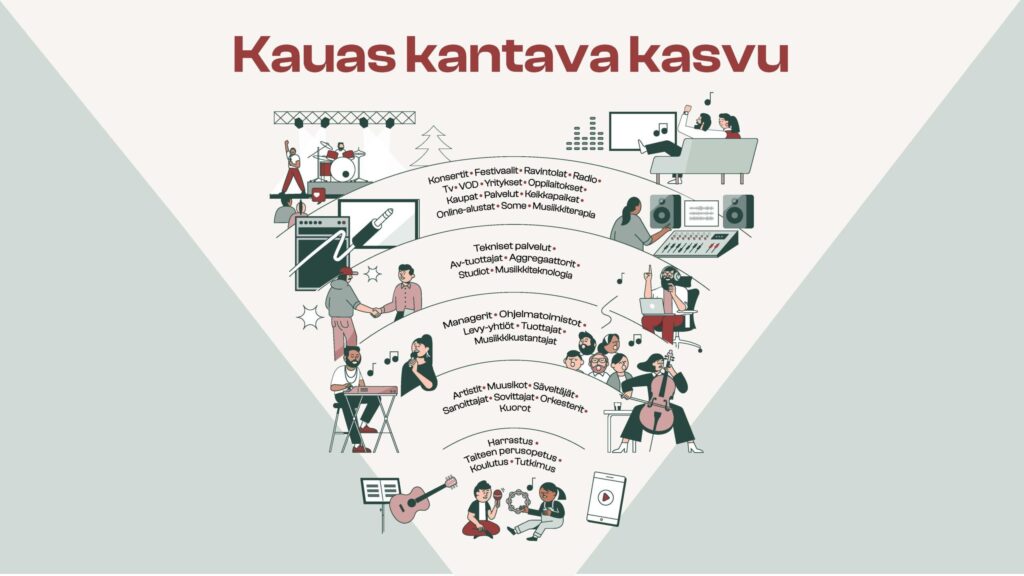
The music industry is an exceptional sector that cuts across society, from early childhood education to the professional music industry, reaching everyone from young children to older generations. The value of the music industry has grown steadily at an annual rate of around 10 percent, reaching EUR 1.4 billion in 2024. The music industry is able to generate employment and economic growth in Finland while also strengthening national identity, resilience and people’s wellbeing.
A key objective of the cultural policy report adopted in 2025 is to double the share of the creative industries in Finland’s GDP. The music industry plays a central role in achieving this goal. However, this requires that the implementation of the cultural policy report and the growth strategy for the creative industries is promoted across sectors and ministries. Clear priorities, measures and timelines must be established for implementation, and their progress must be systematically monitored and evaluated. The goals outlined below cover the entire music sector and have been compiled jointly by Finnish music industry organisations.
1. Stable, predictable and growing cultural funding
Strengthen funding and growth measures for the arts, culture and the creative sectors in line with the cultural policy report, for example by increasing the predictability of public funding through multi-year funding plans. Establish a programme to raise the cultural budget to one percent of the state budget.
Restore the funding cuts made to the music industry by the previous government as part of a new growth package for the creative sectors.
Develop the role of established, state-funded organisations as drivers of the Finnish music industry and promoters of diversity. Strengthen their collaboration with artists, freelancers and companies, with a particular focus on contemporary domestic music.
Integrate the promotion of equality and diversity as a core element of all cultural policy, ensuring that future funding calls encourage and reward long-term work in this area. Monitor progress systematically.
Enhance the participation of the creative sectors in decision-making affecting the field. Establish a cross-ministerial body, in line with the cultural policy report, to support the implementation of the report and related policies. To enable broader work, set up thematic working groups under this body, for example a group focused on developing social security.
2. Regional accessibility of music and cultural wellbeing – music as a right for everyone
Ensure that everyone has the opportunity to engage in music as a hobby and to develop their skills over the long term.
Safeguard everyone’s right to music by ensuring that both performances and opportunities to create and perform music reach people regardless of where they live or their background. Improve the availability and accessibility of music, particularly for children and young people as well as for different minority groups.
Increase access to music in different ways for citizens at risk of social exclusion, in cooperation with municipalities, wellbeing services counties, educational and care institutions, and music industry organisations.
Strengthen cooperation between municipalities, wellbeing services counties, educational institutions and various music sector stakeholders to ensure that music reaches everyone regardless of background or place of residence.
Strengthen the role and consideration of cultural policy within the system of central government transfers to local authorities.
Take into account the wellbeing effects of music, both in prevention and in therapy (including, for example, clinical care guidelines and reimbursement by social insurance systems), when developing and establishing cultural wellbeing activities.
Ensure that services and content related to cultural wellbeing are better reflected in funding and structures, recognizing them as a universal right and as enablers of a good quality of life.
3. Music education that reaches children and young people
Ensure the implementation of the proposed EUR 10 million increase in funding to improve the accessibility and coverage of basic education in the arts.
Develop the Finnish model for hobbies so that it more effectively reduces disparities in participation in music activities among children and young people from different backgrounds. Provide a pathway through the model to long-term, goal-oriented engagement in music.
Strengthen the role of music education in early childhood education as well as in pre-primary and basic education. Enhance cooperation to make professionally delivered music education a free part of early childhood education nationwide.
Strengthen the educational pathway within the music sector from basic education in the arts to vocational education and higher education, and intensify cooperation within the national network of educational institutions to support skills development and ensure smooth transitions between different stages of education.
Take into account the specific characteristics of the arts in the funding structures across all levels of education.
4. Strong copyright protection also in the age of AI
Defend strong copyright protection and the enforcement of creators’ rights both at EU level and domestically – including in the context of artificial intelligence.
Ensure effective enforcement of regulation and adequate resources for both regulatory development and supervision.
Reform the private copying compensation system to align with EU legislation and with the systems in place in other EU countries.
Ensure that copyright protection is upheld also in the context of AI. The use of a work always requires the creator’s permission and appropriate remuneration whenever a service operates within the EU, regardless of the company’s country of origin or where the AI model has been trained.
Safeguard the protection of voice and personality rights as the use of AI expands.
Ensure access to information and sufficient investigative powers in combating copyright infringement. Raise the maximum penalties for copyright offences to the level of other economic crimes.
5. Growth of the music market and increased exports
Continue the determined implementation of the growth strategy for the creative economy in cooperation with companies in the sector. Recognise the specific characteristics of music and other content-driven industries, such as value creation through copyright and, on the other hand, the significance of live music.
Facilitate funding pathways for creative sector companies by reforming the criteria and interpretation of business support in cooperation with Business Finland. Develop new funding solutions that take into account the valuation of intangible assets, solo entrepreneurship and network-based ways of working.
Develop the business of creative content into a national flagship initiative that accelerates both public and private investment in the development, production, export and marketing of creative content.
Expand the national RDI (research, development and innovation) approach to also cover artistic innovation, where artistic development work, innovation and growth policy, as well as the internationalisation of the creative sectors, form a continuous whole.
Strengthen the role of the creative industries as part of Finland’s international image by launching a programme to promote cultural exports and making the creative sectors a key priority within Team Finland’s export efforts.
Provide support for the internationalisation and export of music, culture and the creative sectors in the same way as for other export industries. Recognise music events as platforms for internationalisation, ensure support for internationalisation from the Ministry of Education and Culture, and return export promotion measures to the Ministry of Economic Affairs and Employment.
Restore the value-added tax on tickets for music events and on sheet music to the previous level of 10 percent.
Introduce legislation on professional event production that recognises the entire event sector as its own industry. Streamline regulation affecting music events to make it nationally consistent and predictable.
Oblige content-sharing services to measure and increase diversity and to broaden their content offerings to include smaller genres and language areas.
6. Fair social security and working conditions for music industry professionals
Ensure that self-employed individuals and freelancers also have fair access to unemployment and pension security by removing barriers to eligibility, such as the current interpretation of self-employment. Clarify support criteria that do not adequately take into account irregular income, grants and small-scale entrepreneurship.
Reform the pension system for entrepreneurs so that, at a minimum, pension contributions for low- and middle-income entrepreneurs are based on actual income rather than imputed earnings.
Make all work worthwhile by ensuring that personal initiative does not lead to the loss of social security benefits. Remove disincentives that hinder part-time entrepreneurship and restore income disregards.
Ensure that decisions related to social security are based on accurate information about a person’s actual employment and income situation – including cases where income is accumulated irregularly from multiple sources. As a rule, a person’s own declaration should be trusted. This applies both to determining pension contributions and to assessing eligibility conditions for employment-based benefits.
Take grants and copyright income into account when developing social security systems, ensuring that these forms of income are treated fairly in relation to other types of income.
In collaboration with the music industry
Gramex
GT Musiikkiluvat
IndieCo
LiveFIN
Manager’s Forum Finland
Music Finland
Musiikin edistämissäätiö
Musiikkituottajat IFPI
Muusikkojen liitto
Sulasol
Suomen Jazzliitto
Suomen konservatorioliitto
Suomen musiikinopettajien liitto
Suomen Musiikintekijät
Suomen Musiikkikustantajat
Suomen Musiikkineuvosto
Suomen musiikkioppilaitosten liitto
Suomen Sinfoniaorkesterit
Suomen Säveltäjät
Taideyliopiston Sibelius-Akatemia
Teosto
Download the full set of goals on the Musiikkiala.fi website