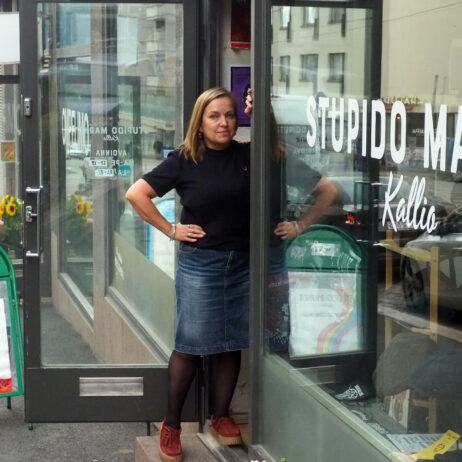
A musician for musicians

When the new President of the Musicians’ Union took office, it was a busy start.
“I have started as President at a time of great change in the Union. It has been a very busy start. But I am very motivated to work because the issues are diverse, relevant and exactly what I want to work on and for. Cooperation with both the staff and stakeholders of the Union has also started well. I am very happy about this,” Kari says.
The recent Gramex vice-presidency is also important to Kari.
“Gramex is a vital player for us musicians, ensuring that musicians and producers who perform on recordings are fairly compensated for their work.”
Kari says he was impressed by the high level of sophistication Gramex has reached in collecting compensation and paying it to rights holders.
“Gramex’s administration and operations as a whole have also proved to be very professional.”
Long career as an orchestral musician
Mia Kari, from Järvenpää, started her musical hobby with piano and later went on to study French horn in music classes.
The educational path led him through the Sibelius High School to the Sibelius Academy and finally to a career as an orchestral musician. He has played in the Lahti Symphony Orchestra for decades as assistant conductor and has also worked as a teacher of French horn and in event productions.
“I’ve always been interested in organisations. Being a trustee of the orchestra sparked and gradually deepened my interest in musicians’ advocacy. This interest was strengthened to the extent that I applied to join the Board of the Federation of Musicians and was elected to the Board. I have been on the board since 2009,” Kari says.
Later, she has complemented her knowledge with studies in business and law, which has brought her a new perspective to musicians’ advocacy work.
Music does not come from nothing
Mia Kari also continues to receive Gramex compensation herself.
“For me, it’s a relatively small part of the income, because I’ve mainly made recordings as a member of an orchestra or other large ensembles. But I know that for many musicians, Gramex royalties are an essential part of their income. It is therefore important to ensure that the system continues to work fairly and efficiently.”
Kari sees copyright as a bigger issue than making a living.
“For me, copyright means that creative work is recognised – it’s a fundamental professional right. Music does not come from nothing, but from the musician’s skills, time and dedication to it,” says Kari.
Better competitiveness through cooperation
At Gramex, Mia Kari intends to promote issues of both principle and practice:
“As I represent the artists’ side in Gramex, it is naturally my job to make sure that the artists’ perspective and rights are well represented in the work of the board. I also attach particular importance to the continuous development of accounting systems, for example. This will ensure that the compensation is channelled even more accurately to the right performers and producers.”
As regards copyright issues, the focus in the near future will be on issues related to AI education and, in the work of the Musicians’ Union, on musicians’ streaming royalties.
“I think it is important that we can expand licensing to new services and products to create new revenue streams. A good example of such projects is Gramex’s licensing of recordings for podcasts, which will start in 2026.”
In the longer term, Mia Kari’s aim is to strengthen the financial base of the music sector as a whole and the well-being of musicians. To achieve this, she hopes to work in a solution-oriented way.
“Solution-oriented cooperation with the producer side strengthens the competitiveness of the whole sector. This will ensure the vitality of music and the position of rights holders in the digital environment.”
The conditions for making music work
Although music is highly valued in Finland, he sees challenges in the working conditions of professionals. According to Kari, the appreciation is not always transmitted to the everyday life of professionals.
“I think music is very much appreciated in Finland: people listen to music, go to gigs, concerts and festivals. Although music is present in many ways in people’s everyday lives, the appreciation of the work is not always conveyed to musicians and professionals in terms of the conditions they have to do the work. Economic realities, cuts in cultural funding and a rapidly changing environment challenge professionals more than is perhaps realised.”
That is why Mia Kari believes that the whole sector needs to discuss how music should be seen as a way of life in society.
“The value of music is enormous, but its creators must also be able to make a living from it.”
“At the Union, we are working on both immediate needs and longer-term developments. In the short term, the most important is to improve social protection and safety nets for freelancers and the self-employed. Working conditions, contractual models and salary levels also need to be developed both in the field and in orchestras in order to strengthen musicians’ livelihoods,” Kari lists.