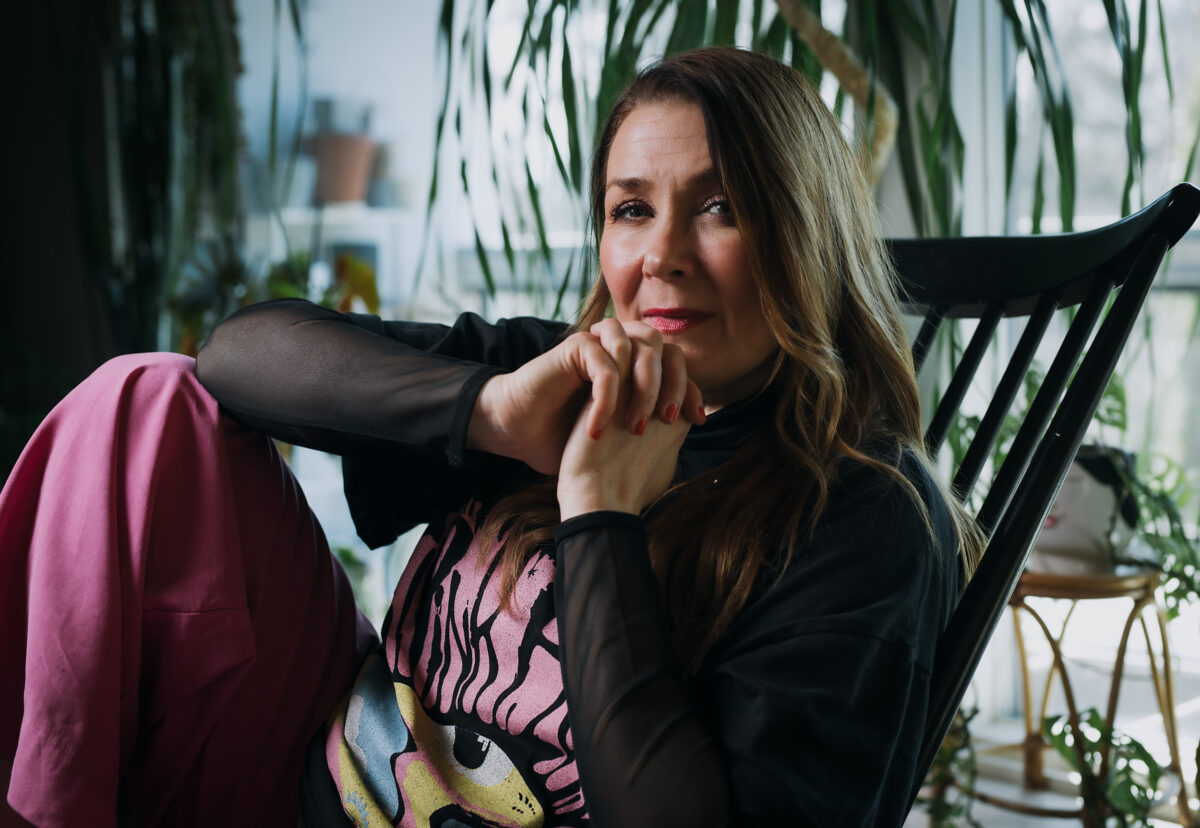
From the windows of the house, the view opens onto a park. Beyond it, the Jyrängönvirta river, a tributary of Lake Päijänne, glistens in the sunlight. Irina rocks gently in a rocking chair in her living room, gazing at the scenery.
The room is lush with greenery. Off to the side, stacks of jigsaw puzzles are piled on the floor.
Irina’s teenage son bursts into the apartment.
“Dentist at half past one, remember,” Irina calls out.
“Yeah,” her son replies before heading into his room.
This could be the home of almost any middle-class mother in Heinola who loves jigsaw puzzles and houseplants—and in many ways, Irina is a fairly typical resident of Heinola. The town’s average age is 49, and Irina is almost exactly that age: fifty years old.
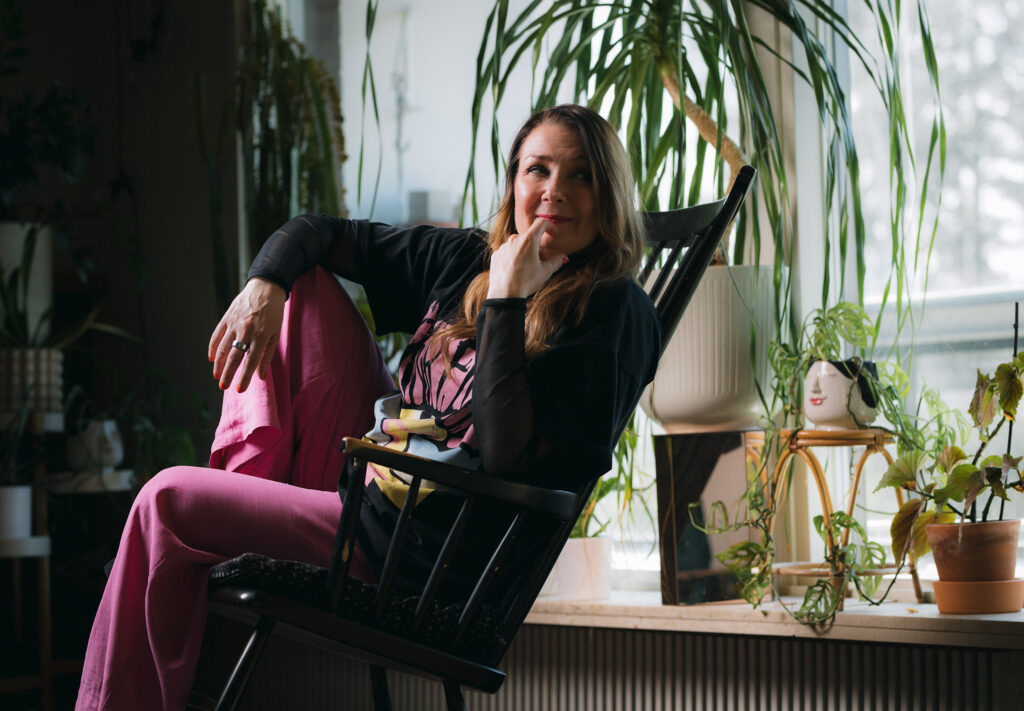
What separates her from the average passer-by is, of course, that Irina is a pop star. In the Finnish context, she is a well-known celebrity—more easily recognised on the street than government ministers. Around half of Finns could probably sing at least a few lines from the choruses of Kymmenen kirosanaa or Pokka.
Now, Irina is doing what many people her age are doing: she is considering a new direction for her career.
“Maybe a garage rock album? I love El Camino by The Black Keys,” Irina says.
The rocking chair creaks.
“I don’t know. I think I’m a bit tired of Irina,” she says, then laughs.
At fifty, it feels appropriate to reflect on such things. At that age, people are seasoned professionals, yet still young enough for their greatest achievements to lie ahead. CEOs, doctors, lawyers, writers, researchers and visual artists often reach their peak later in middle age.
But in the profession of a pop star, age carries a different meaning. For pop stars, the best-before date can arrive early.

Youth sells, decade after decade. That was the case with Janis Joplin, Madonna, Nirvana, the Spice Girls, Taylor Swift and Sabrina Carpenter.
In pop music, the most significant achievements are often made at a very young age. Paul McCartney had not yet turned 28 when The Beatles had already broken up. Billie Eilish had sold hundreds of millions of records and won both a Grammy and an Oscar before she was even old enough to legally drink alcohol.
Boy bands know that old age arrives early, as do artists like Britney Spears and Christina Aguilera.
The pop business is like the fashion industry: a worship of youth—and of novelty. When Bruce Springsteen was starting out in the early 1970s, he was billed as the new Bob Dylan. Apparently, a new Dylan was needed, even though Dylan himself was only 30 at the time.
The glorification of youth and ageism are widely criticised today, yet they have not disappeared—quite the opposite. Never before has cosmetic surgery been so normalised; these days, you can book “lunchtime Botox” during a workday break. TikTok and Instagram are overflowing with content in which the beauty ideal of youth floods relentlessly into the soul through the eyes. The imagery shouts: smooth, slim, fresh, firm, young.
In our culture, we learn that youth is not only surface beauty but also beauty of the soul. It is intensity and unstoppable desire, belief and the need to save the world—before passion is reduced to mundane routine: a craving for comfort, a rocking chair, jigsaw puzzles and houseplants.
Irina, too, remembers what it is like to be a young artist. For although she broke through in the pop world at what is considered a relatively late age—nearly thirty—she started early.

Irina had been touring with her musician father since childhood and was already a confident performer as a small child in music play school. In her twenties, she was part of a band called Playa. Like many young bands, Playa played gigs relentlessly and did promotion at full throttle.
“We were supposed to be the next Aikakone, but that’s not how it turned out,” Irina says.
The breakthrough never came, and Playa eventually became a cover band. In that field, things went well: the band played more than 100 shows a year.
“I was happy that there were so many gigs that I didn’t need to take out a student loan. Of course, I dreamed of performing my own songs—of having the audience sing along to music I had written myself.”
In 2002, Irina was travelling with friends to a wedding in Kauhajoki when they offered a lift to an acquaintance, Toni Wirtanen. At the time, Wirtanen was working on music for a television series called Julian totuudet, and he asked Irina whether she would like to sing the theme song. Irina sang it. A couple of weeks later, Wirtanen asked if she would like to make a full album of her own music.
The rest is an exceptionally successful chapter in Finnish pop history.
Irina’s debut album Vahva was released in 2004 and broke through immediately. She was nearly thirty at the time—an age that can already pose a challenge for artists still trying to achieve their breakthrough.
In Heinola, Irina realises that she has set the table without butter or cheese for the bread. She fetches what’s needed from the fridge and lays everything out.
Irina does not recall anyone ever making an issue of her age at the time of her breakthrough, despite the fact that she was a relatively mature new pop artist.
“There was no talk about it at all. What I do remember is feeling inferior to Maija [Vilkkumaa] and Jonna [Tervomaa]. I thought of myself as a discount Vilkkumaa,” Irina says, laughing again.
She is one of those people for whom it is hard to believe they ever have a bad day. Her smile comes easily, and her laughter bubbles up often.
Even in the media, Irina’s age was never raised as a topic—quite the opposite. In a concert review published by Rumba magazine, for example, Irina was described as an energetic new talent, glowing with the allure of novelty. Her energy felt ageless. Some people and bands possess this quality, for one reason or another.
Nick Cave and David Bowie never seem old or outdated. Lucinda Williams and Kate Bush are always cool. The guys in Foo Fighters and The National are middle-aged men, but they carry their age with dignity—and while Pulp’s breakthrough in the 1990s was all about youthful decadence, Jarvis Cocker still comes across as a pretty cool guy.
In contrast, there is a long list of ageing artists and bands who feel hopelessly dusty—the kind whose concerts almost make you feel embarrassed on behalf of both the artist and the audience: haven’t we gotten anywhere in life?
Mark Hoppus of Blink-182 could sing “What’s My Age Again?” with good humour back in 1999. But if he does it today, at the age of 54, it starts to feel more bittersweet than funny.
Niko Kangas, Head of Export at Music Finland, says that age is closely tied to musical genre.
“In heavier music, for example, it is more the rule than the exception that band members are already older. The same applies to rock music. That’s why it’s possible to break through at a later age in those genres,” Kangas says.
This is largely due to audiences. Rock and metal listeners today tend to be older. It is the music of their youth, and bands and artists have aged alongside their fans.
“But if you try to break through as, say, a more electronic pop act or a rapper in middle age, that can be a problem,” Kangas notes.
There are always exceptions to the rule. Snoop Dogg is a rapper, yet somehow he slips effortlessly onto festival stages filled with twenty-somethings. For one reason or another, some artists just work, without any rational explanation. Kangas sums it up:
“You simply have to be the right kind of person doing the right kind of thing.”
Irina was the right kind of person doing the right kind of thing. When she broke through, she was not making teen pop, rock or traditional schlager, but a hybrid of all three—a kind of adult music that still felt young. It is telling that although it is almost impossible to listen to Irina’s music live without dancing, she is still placed in the schlager category at the Emma Awards.
Irina’s breakthrough was also supported by her experience as a performer and entertainer.
“In Playa, I learned that if you don’t want to get trampled on stage, you really have to know how to go wild,” she says.
It also helped that Toni Wirtanen was by her side—a rock-credible figure who, in a way, gave Irina his “seal of approval”.
“There was probably something in the fact that I was interesting partly because of Toni,” Irina says.
This was a winning formula in the mid-2000s, and Irina’s first three albums sold faster than half-price coffee. By the time of her fourth album, however, the question of age shifted from a number to biology.

Age is a sensitive issue. That is why it is rarely discussed openly in the music industry, even though, according to Niko Kangas, it is thought about a great deal.
“If you are a middle-aged artist and, for some reason, an industry gatekeeper ends up listening to your song, age almost invariably becomes part of the decision-making process,” Kangas says.
The issue is not necessarily that record labels would doubt the appeal of an older artist or band. It is about practical considerations. Can an adult commit to their career with the same level of dedication as a younger person?
“If an artist or band starts out in their thirties or forties, it is often inevitable that there is more to life than just music. Then the question arises of whether those long tours are really feasible. From a management perspective, tours are expensive, and there is always the risk that band members have other commitments,” Kangas explains.
There are children’s ice hockey practices, housing association meetings, office Christmas parties and weekends spent visiting in-laws. Whatever little free time remains is often used to recharge.
“That’s why the biggest push and the breakthrough usually happen between the ages of 20 and 30,” Kangas says.
From the perspective of the pop business, youth also has other advantages. A young person’s ability—and willingness—to say “no” is often still underdeveloped. Young artists are easier to steer and shape than older ones. They have stamina, do not yet know their limits, and that suits the music business very well.
“The music business has always been ready to extract maximum efficiency from whatever opportunity presents itself,” Kangas says.
And although Kangas does not say this out loud, it may also play a role: if you are a woman in your early thirties, there may be an assumption that starting a family could soon be on the horizon.
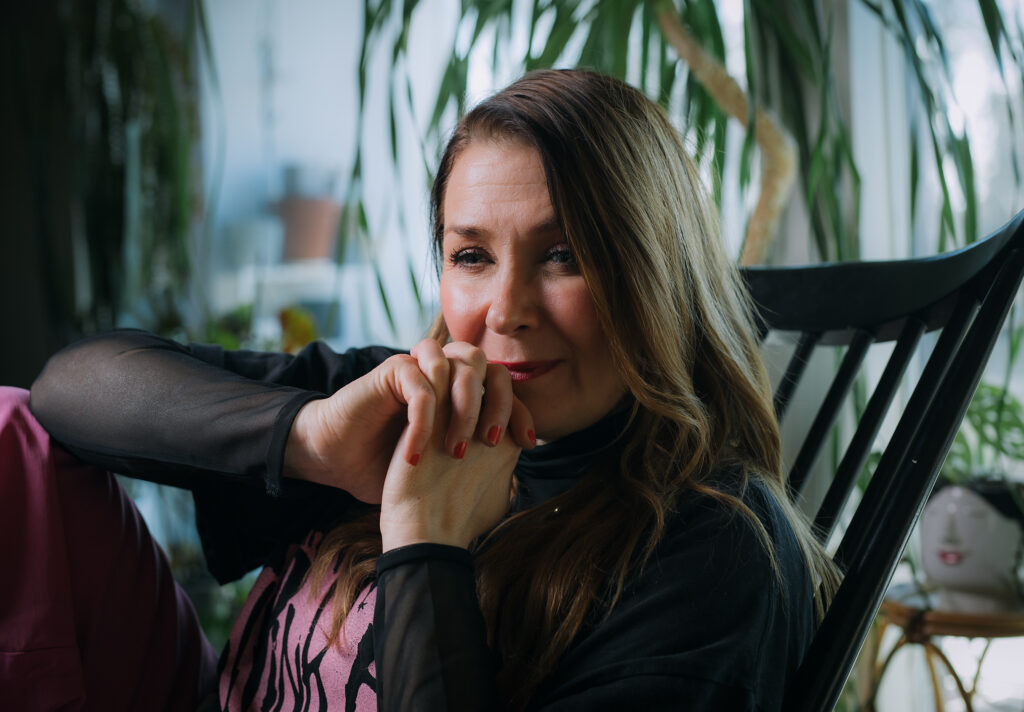
In Heinola, Irina brews a fresh pot of coffee. Her son has left for his dentist’s appointment.
Irina’s first three albums marked a steady rise following her breakthrough. By the time of her third album, Liibalaaba, she was just over thirty.
Then a crisis hit.
“My career was at its peak, but it felt like I was supposed to start thinking about having children and getting married. About all those things women are expected to do. I felt this strong resistance—that no one gets to tell me how I should organise my life,” she says.
In the end, Irina decided that if a child was meant to come, it would come. And it did. After her third album, she took a break of about a year.
“I thought that maybe I wouldn’t be forgotten straight away, even if I was away for a while.”
Irina does not feel that having a child created additional problems for her career. Of course, a child adds an extra layer of planning, but in her view, starting a family is not actually a major issue in an artist’s work.
“If you think about the members of PMMP, they managed just fine. Or take Haloo Helsinki!—they went on arena tours very quickly after Elli had her child.”
Looking at the sales figures, Irina’s career began to decline from her fourth album onwards. This was undoubtedly influenced by the four-year break she took after Miten valmiiksi tullaan. On the other hand, the drop in sales has more to do with changes in the world than with any loss of Irina’s popularity: no artist has been able to maintain strong sales figures as the market for physical recordings has collapsed.
“And there have always been plenty of people at the gigs,” Irina says.
Her 2013 album Askeleita still achieved gold status, but the reception of the subsequent Mikä mahtaa olla in cover album was more subdued. On the album, Irina performed Finnish songs from the 1970s to the 2000s that she had personally selected, backed by a 13-piece orchestra.
“While making it, I thought it would probably turn out to be commercially unviable crap. And it did!” she says, laughing. “The fans didn’t like it, but it was a wonderful leap away from Irina.”
Irina made the album Seitsemän when she was just over forty. At that point, outsiders began to comment on her age for the first time.
“In one album review, it was said that I’m age-wise difficult. That I’m no longer young, but not yet Kaija K either—somewhere in between.”
Irina has always been hard to pigeonhole, and pigeonholes are something pop media loves. Everyone needs to be placed in a box so that an artist can be evaluated within a familiar framework. But Irina didn’t quite fit into any box at the beginning of her career—and she still doesn’t. Except for her own Irina-shaped box.
And now, she wants out of it.
Irina has returned to the rocking chair. She talks about how tired she has become of Irina. She is constantly being offered new songs to sing, and she is genuinely grateful for that. But every time a song is sent her way, it is more of the same.
“People message me saying, ‘Hi, we’ve made a song that we think sounds like Irina—would you like to hear it?’ And then I think: OK, is it Pokka or Kymmenen kirosanaa? Those songs have already been made!”
The rocking chair creaks, and Irina starts to get animated.
“I often think: don’t offer me what I’ve been—offer me what I’m going to be. I want to sing something new, to move in a different direction. For example, the most fun part of Elämäni biisi was singing Sabotage by the Beastie Boys!” Irina says—and laughs again.
“Next, I’d maybe like to make something really raw and live-driven—garage rock. I love albums, but at the same time I’m also interested in just firing things out there. Releasing songs the way young people do and seeing what takes off.”
Is it realistic? After a twenty-year career, could a fifty-year-old artist in the pop world change direction—find a new breakthrough?
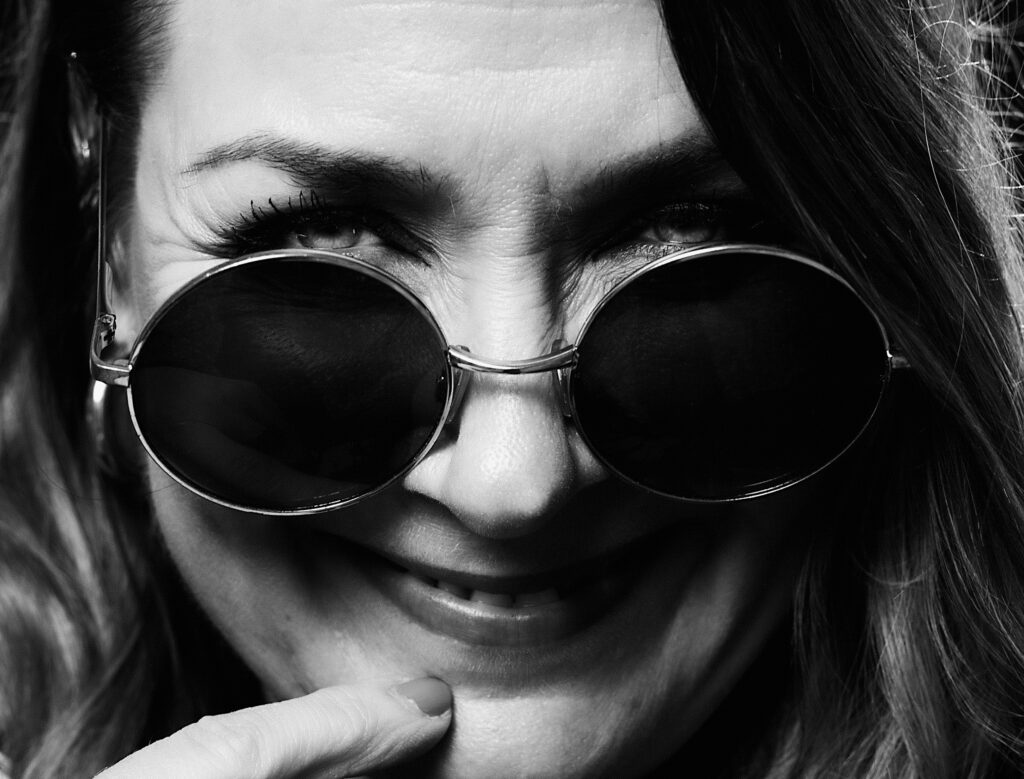
For everyone, it is not possible. In pop music, age does matter.
But when Irina makes eye contact and flashes a grin that looks like she has just pulled off a world-class prank, one thing comes to mind—what Niko Kangas said: all it takes is the right kind of person doing the right kind of thing. And then, age does not matter at all.
Article published in May 2026.
Yona: The anatomy of a breakthrough

